
I accidentally cut off the end of my left middle finger yesterday and am wearing a massive bandage that makes it difficult to type. As I sit here, worrying about whether this will make me Even More Disabled, I also am moved to thinking about how much I value being able to bring a critical disability lens to my work as a therapist.
Ableism affects us all, even the non-disabled. Ableist attitudes can often be a source of some of the distress in our lives. If you’ve ever thought, “What’s wrong with me that I can’t get over my trauma?” or felt shame about not keeping up with laundry during an intense episode of depression or ADHD burnout, you’ve probably internalized some ableist attitudes.
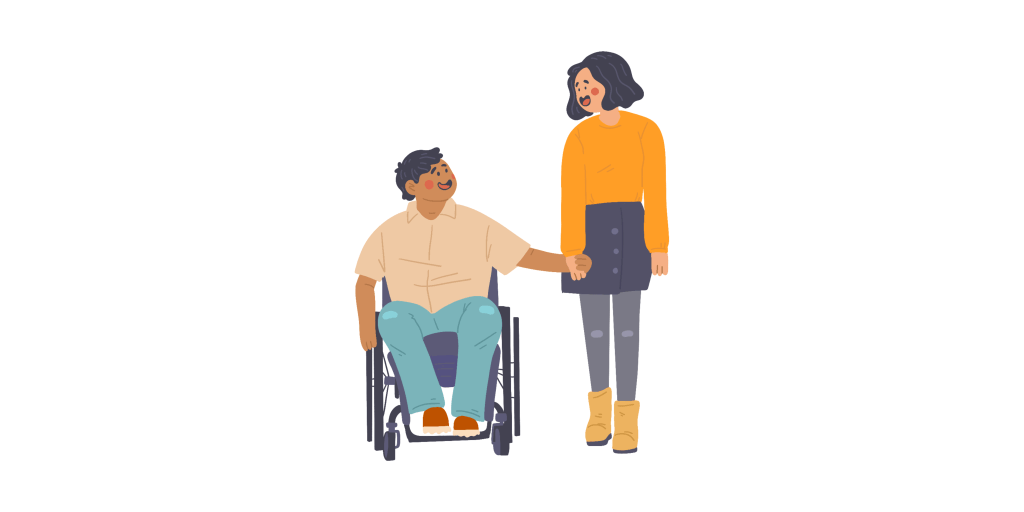
Ableism wants you to believe that if you’re not living your life up to the normalized capitalist, White supremacist standards, you are less than or don’t have value. If you aren’t being “productive,” you’re not valuable to society, and whatever cause may be behind that “lack” of productivity should be immediately overcome, destroyed, and forbidden to ever exist again. Ableism also doesn’t care whether that cause is PTSD, neurodiversity, depression, or a physical condition that might prevent you from producing a particular type of work that is deemed most valuable in society.
I’m noticing my own internalized ableist thoughts about my finger. “Why did I do this to myself? Now it’s going to be so much harder to work,” I’m saying in my head as if I had intentionally done this (NB: I did not). That shame and blaming myself for this total accident is part of ableism’s trick to try to get you to see yourself as the problem. I’m also catching myself ruminating about the shame I’ve imposed on my family. My wife had to take time out of her own day to take me to the Emergency Room instead of being productive herself. But she doesn’t hate or blame me for this accident (although I do blame the knife AND the lettuce I was cutting…). That’s ableism’s attempts to get you to isolate yourself from those who love you and want to help you.
Critical disability studies teaches us that the problem is not in the person but in the environment. If you’re finding it difficult to “get over” your trauma and the toll it might be taking on your life, I’ve got news for you: PTSD is a healthy, normal reaction to the traumatic experiences you’ve had. If you’re living with complex trauma from childhood experiences, your brain naturally developed in a way that allowed you to pick up on cues of non-safety even faster and more efficiently than other people. Your intelligent, extraordinary brain is certainly not the problem; your childhood environment, with all its trauma, and our current world, with all of its new trauma, discrimination, and an institutionalized lack of compassion for trauma survivors, is the problem. The cultural expectation that you should immediately be able to get over your trauma or keep your house clean when you’re in the pits of a depressive episode is the problem.
I use mobility aids to help me navigate an environment that was not set up to help me get around, and I go to accessible places. Suppose you’re neurodiverse or living with a mental health condition. What are the “aids” that you might need to make the environment more accessible to you? Do you need to keep your self-soothe toolkit on your work desk or backpack? Do you need to hire out your cleaning duties or ask a friend for help?
I know it’s hard to ask for help. When I first transitioned to a disabled body, the shame I felt at the thought of asking a friend to come do the dishes that were piling up (literally) around my house brought me to tears. But I’m slowly learning that interdependence (NB: different from codependence!), is natural and necessary for everyone. We all need from one another, whether physically, emotionally, or spiritually. Ableism tells us to feel shame about that natural state of being. Ableism thrives when we believe we must be so totally independent from one another and are exclusively to blame when we fail to meet those impossible capitalist standards. I need help to navigate a world that was not designed for my body to live in; and you probably do too.
Speaking of aids, I’ll get back to you about those cut-proof gloves for kitchen prep.
TL;DR:
- When you notice that you’re being particularly unkind to yourself, can you trace those thoughts back to an ableist narrative? Are you expecting yourself to be overly independent, or non-human?
- Challenge them by asking for help from people who love you. And then accept the help! Remember, interdependence is natural.
 Dr. Emilie Ellis