Last week, I wrote about how I accidentally chopped (almost) off the end of my finger. It turns out it’s not healing well, and I will likely lose the end of this finger. I’ve been told to expect that, after my stitches are removed, it is going to scab up (gross) and fall off (gross). Also, thanks to Elhers Danlos, I can likely expect it to scar weirdly.
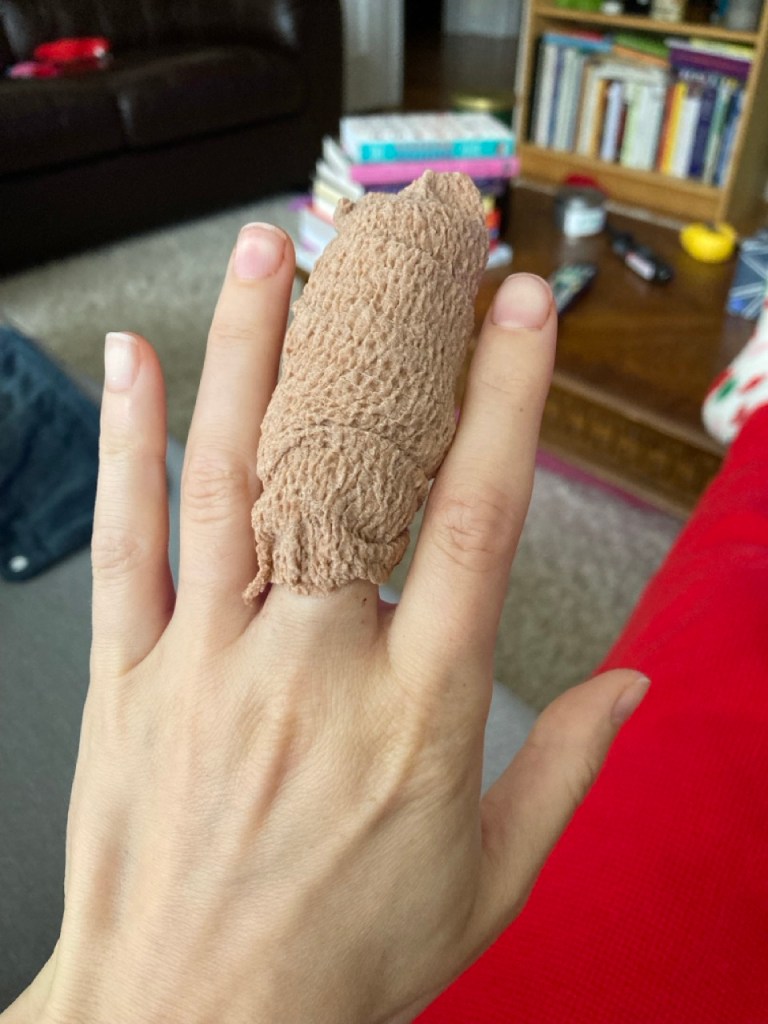
In the grand scheme of My Whole Body, it is truly a small and insignificant part. It’s not likely to affect my dexterity, and it’s not essential for my job (I’m typing without using that finger right now). But I have noticed that what I’m actually concerned about is having a finger that looks different from the rest of my fingers, my wife’s fingers, and everyone else I know’s fingers. Not different in how everyone’s fingers are different (even within the same hand). I’m worried about having a weird finger.
When I first became disabled, I worried about whether my disability would make me less attractive to my partner. It felt so shallow and vain to worry about this. I thought that it should be the least of my concerns. But it was (and, in some ways, continues to be) a real worry. I worried about whether my limited mobility would make me less attractive. I worried that using a wheelchair would make me less attractive.
I know what the correct answer to this question is: no. Why is that so hard to accept? Because culturally, we’ve been told that disabled bodies are less attractive and that they have less value (the roots of which are intimately tied to racism; see these links below1). Whether or not we want to, we internalize these ableist messages, and because I had internalized them, I had already decided that disabled people, including myself, are less attractive than non-disabled people.
Ultimately, my concerns about whether using a wheelchair or having a slightly different-looking finger make me less attractive are less about me or my body and more about my internalized beliefs about what those things mean. Does using a wheelchair mean that I no longer meet those White supremacist, patriarchal beauty standards? Probably. Does having a different-looking finger mean the same thing? Yup.
But I also know all the ways and reasons that those White supremacist, patriarchal beauty standards are problematic and oppressive. For a while now, I’ve been learning from people doing parallel and connected work to unlearn things like internalized racism and anti-fat bias as a means of understanding my privilege as a White thin-bodied person who, for more of their life successfully passed as a pretty woman who was desirable per the male gaze.
So where does that leave me (and my finger)? On the journey to accepting and loving myself and my body as I am, with everyone else. I’ve come to learn that this particular healing journey is as difficult as it is (for some) to address many other body-related and/or appearance concerns, such as seeing the inherent beauty in your dark skin or loving and cherishing your belly. I have to look at my body and see the beauty in it, and not just the parts that White men have told me are acceptable.
It also means I can’t pick and choose what parts I accept and what parts I don’t. I can’t love my electric wheelchair-using, disabled body with its inability to walk short distances, but resent the recent weight I’ve gained. I can’t accept my hips as they are, despite them bringing on some gender dysphoria, while I hate my adult acne. I have to love and accept my whole self all at once (finger included), even if loving it section by section is easier on some days.
But how do I accept my body? The ultimate question! It’s a personal journey for everyone. I’ve worked hard to find and build more moments where I love my body. Such as finding things I enjoy and can still do (such as writing) and times I find myself attractive, like when I go on a date with my wife. Slowly, over time, these have built up so that I can counter any questions about my value as a disabled person faster and more effectively (i.e., I believe myself). There are certainly some tips and tricks that help: using mobility aids that feel like they represent you helps a ton. In the same way that I don’t like how some shirts look on me, I prefer to be seen using my clear cane for its style, instead of my first cane.
But ultimately, the work is inside. And it’s the most challenging work. I wish I could buy self-love and self-acceptance, but then what would I learn about loving others?
- Links:
Podcast: Ableism & Racism: Roots of The Same Tree (https://www.pushkin.fm/podcasts/be-antiracist-with-ibram-x-kendi/ableism-racism-roots-of-the-same-tree)
Book: Fearing the Black Body (https://nyupress.org/9781479886753/fearing-the-black-body/) ↩︎
 Dr. Emilie Ellis